Last Updated: April 2026
TL;DR:
- Technically yes — any ring can be used as an engagement ring if both partners agree to that meaning. But a promise ring lacks the explicit proposal context that makes an engagement ring an engagement ring.
- The meaningful difference isn’t the ring itself — it’s the conversation and intent. A diamond solitaire given with no proposal isn’t an engagement ring either; a plain band given with a clear marriage proposal absolutely is.
- If you want to use a promise ring as an engagement ring, say so explicitly. The ring doesn’t communicate that — you do.
The question comes up more often than people expect, usually in two scenarios: someone who wants to propose without a big diamond, or someone reconsidering whether a ring they already gave signals more commitment than originally intended. I’ve sold both promise rings and engagement rings for over two decades, and the confusion between them is almost always about expectations, not jewelry. Here’s how to think through this clearly. For related reading on what counts as a valid promise ring, see our answer to whether any ring can be a promise ring.

What Is a Promise Ring, Exactly?
A promise ring is a ring given to signify a personal commitment — most commonly a pledge of monogamy in an exclusive relationship, but also used for friendship promises, purity pledges, or other personal values. Promise rings have been exchanged since the late 1500s in Europe as “posy rings” (rings engraved with short poems or promises). They don’t carry a specific legal or religious meaning — the promise is entirely defined by the givers.
The range of what a promise ring can mean is deliberately wide. That’s both its strength (flexibility) and its weakness (ambiguity). A promise ring given without clear communication can be interpreted very differently by the giver and receiver — one party sees a stepping stone to engagement; the other sees a gesture of affection with no timeline attached. According to the documented history of promise rings, the jewelry’s meaning has always been personal and contextual rather than universal. For matching promise ring options that make the gesture more formal, see our roundup of matching promise rings for couples under $100.

What Makes an Engagement Ring an Engagement Ring?
An engagement ring is a ring given specifically as a formal proposal of marriage — the ring is the physical token of a verbal commitment to wed. The engagement ring tradition in Western culture traces to Ancient Rome (betrothal rings), was formalized by Pope Nicolas I in 860 AD (requiring a ring as part of a formal betrothal), and was culturally transformed by Archduke Maximilian of Austria’s 1477 diamond proposal — widely credited as the first diamond engagement ring on record.
The critical element is the proposal — the explicit statement “Will you marry me?” and an affirmative answer. A beautiful diamond ring given without that explicit proposal context is not, technically, an engagement ring. It’s a gift. This is why the “meaning” of a ring comes from the exchange, not the metal and stones. The ring is a symbol; the proposal is what activates that symbol’s specific meaning. For more on the significance of the stones and settings that traditionally go into engagement rings, see whether 18k gold is a good choice for an engagement ring.
Key Differences: Promise Ring vs. Engagement Ring
Difference 1: What the Ring Means
A promise ring means commitment to a relationship — to each other, right now, with no specific future obligation attached. An engagement ring means commitment to marriage — a formalized agreement to become legally and sacramentally bound. The difference isn’t a matter of degree; it’s a categorically different promise. Confusing the two is the source of most promise-ring-to-engagement-ring conflict.
Difference 2: Timing
Promise rings are typically given earlier in a relationship — before someone is ready to propose marriage, but wanting to signal serious intent. Engagement rings come later, when both parties are ready to commit to a wedding timeline. There’s no rule about how long the gap between promise ring and engagement ring should be — but giving a promise ring immediately followed by an engagement ring proposal raises the question of why the promise ring existed at all.

Difference 3: How the Ring Is Given
Engagement ring proposals typically involve a deliberate, often planned gesture — getting down on one knee, a special setting, a meaningful question. Promise rings carry no required protocol. They can be exchanged casually, given as gifts, or bought together. The absence of ceremony around a promise ring exchange is part of what distinguishes it from a proposal — even if the jewelry is identical.
Difference 4: Appearance and Design
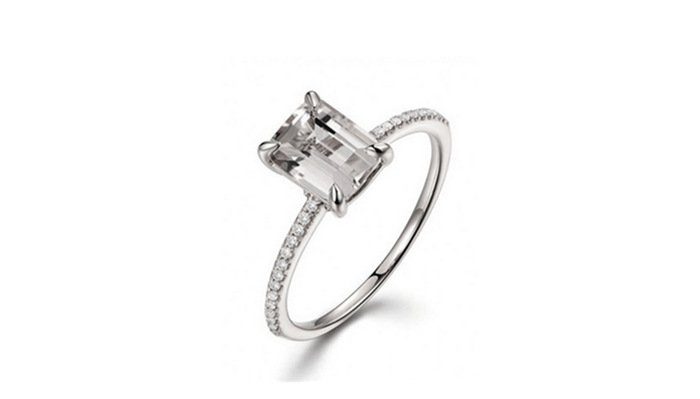
Engagement rings traditionally feature a center stone — most commonly a diamond — in a solitaire or halo setting that emphasizes the stone’s size and quality. Promise rings typically have more varied designs: bands with small stones, colored gemstones, heart motifs, or simple metal bands. That said, these are conventions, not rules. A promise ring can feature a large diamond; an engagement ring can be a plain band. The Knot’s 2026 jewelry survey shows that non-traditional engagement ring choices — colored stones, alternative metals — have increased significantly, blurring the visual distinction further.

Can You Propose With a Promise Ring?
Yes — absolutely. If you have a promise ring and want to use it as an engagement ring, say so explicitly during the proposal. “I want to marry you, and I want this ring — the one I gave you as a promise — to be our engagement ring” is a completely valid approach. The ring doesn’t need to change; the stated meaning does. What you cannot do is give or keep a promise ring and expect the other person to infer an engagement they were never told about.
I’ve seen this go wrong in two directions. First: someone gives a promise ring hoping it implies a vague future engagement without committing to one. The receiver thinks it’s a formal pre-engagement step; the giver considers it optional. Second: someone upgrades the meaning of an existing promise ring to “engagement ring” in their head without telling their partner, leading to confusion about whether a formal proposal ever occurred. In both cases, the ring is not the problem — the missing conversation is.

When Does It Make Sense to Use a Promise Ring as an Engagement Ring?
Using a promise ring as an engagement ring makes the most sense when: the ring has strong sentimental value to both partners, the couple shares a preference for non-traditional approaches to engagement, or financial constraints make replacing the ring impractical. The sentimental case is the strongest — a ring with history between two people often means more than a new ring purchased specifically for the proposal.
The one thing to confirm before going this route: that your partner would actually want this. Some people have specific expectations about what an engagement ring should look like and mean — and upgrading a promise ring to engagement ring status without that conversation can feel like the proposal is being shortchanged. For ideas if a new ring is needed, see our roundup of wedding bands and engagement alternatives under $100. For rings that mean something specific by design, check out self-love promise ring meaning — a growing category that’s related but distinct.
The Bottom Line
A promise ring can absolutely be used as an engagement ring — rings don’t have fixed meanings independent of the people exchanging them. What matters is the explicit conversation: clearly stating that this ring now represents a proposal of marriage, and confirming that your partner understands and accepts that meaning. The jewel doesn’t do the work. The proposal does. If you’ve been wondering whether the ring you have is “enough” for a proposal — it probably is, as long as the conversation that goes with it is clear. For more on what kinds of rings carry different relationship meanings, see our post on what different ring placements mean.
Frequently Asked Questions
What finger do you wear a promise ring on?
Promise rings are most commonly worn on the left ring finger (the same finger as engagement rings) or the right ring finger. There’s no universal rule. In the US, wearing it on the left ring finger signals to others that the wearer is in a committed relationship; wearing it on the right ring finger creates less ambiguity. If the promise ring later becomes an engagement ring, it typically stays on the left ring finger — or is switched there if it was worn on the right.
How much should a promise ring cost?
Promise rings typically cost $50–$300. They’re not expected to carry the financial weight of an engagement ring, which often involves a diamond and precious metal at significant cost. The promise ring’s value is in the symbolism, not the material. That said, if you’re giving a promise ring with the specific intention of later using it as an engagement ring, it’s worth investing in quality material (solid gold or sterling silver, not plated) so the ring holds up to years of wear before the formal proposal.
Should promise rings match engagement rings?
There’s no requirement to match. If you’re planning to give a promise ring followed by a different engagement ring later, the two rings can be completely different styles. If you plan to use the promise ring as the engagement ring, there’s nothing to match. If you’re giving promise rings as a couple (both partners wearing one), matching sets have obvious appeal — see our guide to matching promise rings for couples for options under $100.
Is it tacky to propose with a non-diamond ring?
No — and this cultural conversation has shifted significantly in recent years. According to The Knot’s annual jewelry reports, colored gemstone engagement rings, plain gold bands, and alternative stone choices (moissanite, sapphire, opal) have grown as a share of engagement ring purchases every year since 2018. What matters to most people is the intention and the relationship behind the proposal — not the carat weight of a specific stone. A well-chosen non-diamond ring proposed with genuine love and commitment is more meaningful than a diamond chosen without care.

Stephanie is a jewelry lover when she was a teenager. Her major was fashion design when she was in college. She is a jewelry designer at SOQ Jewelry and other design companies. Now she is also a writer for our website. She writes a lot of designs&brands posts with very actionable tips.